


LED Strip Potting
Continuous silicone gel dispensing for flexible LED strip encapsulation — achieving IP65–IP68 waterproof sealing across meters-long production runs without bubbles or bead interruption.
Continuous-Run Silicone Dispensing for Waterproof LED Strip Lighting
Flexible LED strip lighting — used across architectural, automotive, signage and outdoor lighting applications — depends on a continuous, bubble-free silicone gel fill to achieve its waterproof rating while retaining the flexibility that makes strip lighting useful in the first place. Unlike discrete-component dispensing, LED strip potting is a continuous linear process: silicone gel must be dispensed along a channel or silicone tube profile running the entire length of the strip, often tens or hundreds of meters in a single uninterrupted production run, with the same fill volume and quality maintained from the first meter to the last.
The dispensing challenge is threefold: maintaining constant bead volume per unit length despite the mechanical demands of continuous high-speed feeding, ensuring the dispensed silicone remains bubble-free even as air can become entrained during high-throughput dispensing, and selecting and metering a silicone formulation flexible enough to withstand the repeated bending and coiling that strip lighting undergoes during installation without cracking or delaminating from the flexible PCB substrate.
SANCO continuous linear dispensing systems, paired with desktop visual dispensing machines configured for reel-to-reel feed, deliver the sustained volume consistency, integrated degassing and multi-meter run capability required for high-volume LED strip potting production.
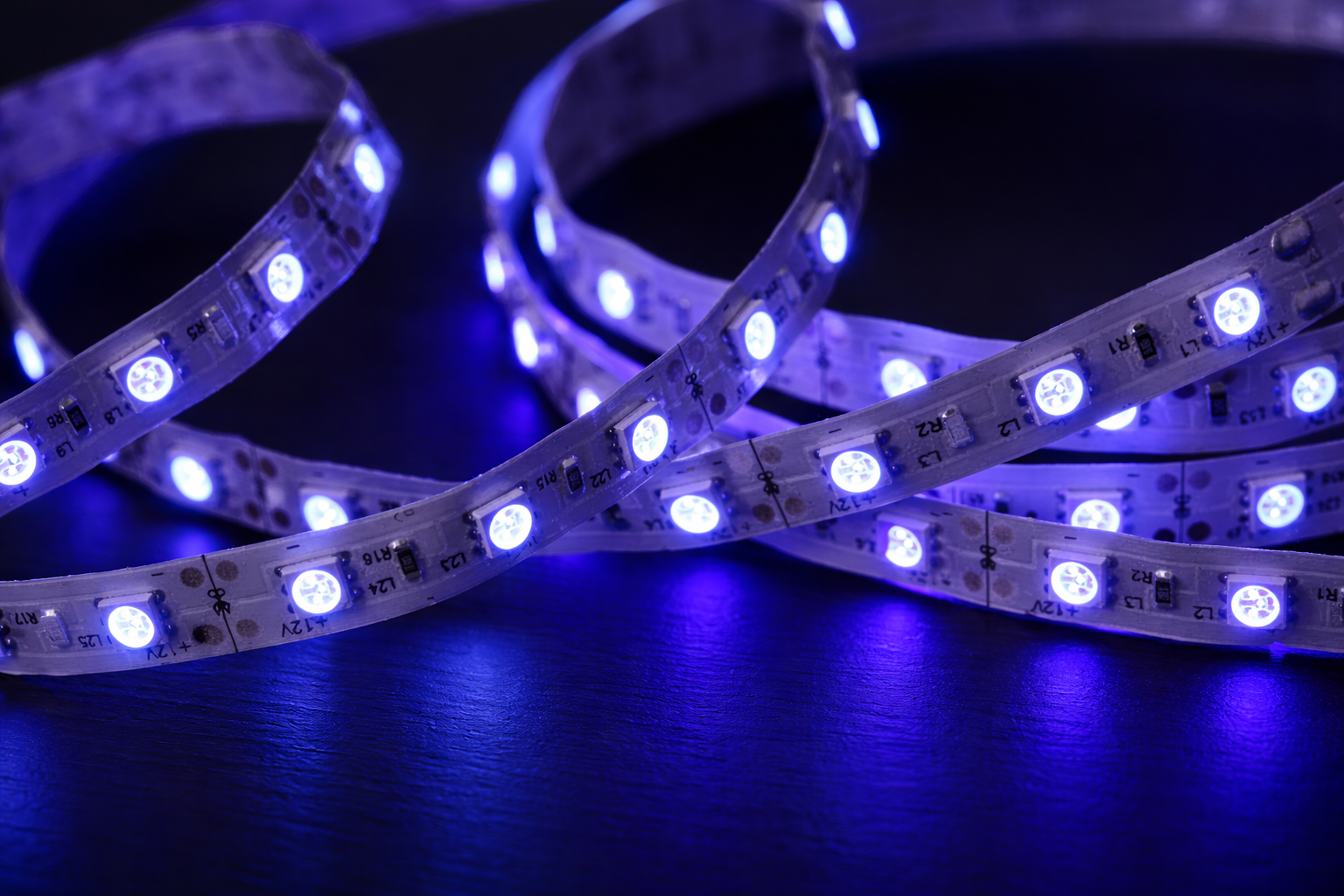
Why LED Strip Potting Requires Sustained Precision Over Long Runs
Unlike discrete-component dispensing, LED strip potting is a continuous process where volume and quality must hold steady across meters or hundreds of meters of product.
Continuous Bead Consistency Over Long Lengths
A single production run can require dispensing a continuous silicone bead over tens or hundreds of meters of strip. Fill volume per unit length must remain constant from the start of the run to the end, without gradual drift as barrel pressure or material viscosity shifts over time.
Bubble-Free Fill in Narrow Channel Profiles
LED strip channels or silicone tube profiles are narrow, and air entrainment during continuous high-speed dispensing can trap bubbles that compromise both the optical clarity and waterproof integrity of the finished strip.
Flexibility Retention After Cure
The cured silicone gel must remain flexible enough to allow the finished strip to be coiled, bent around corners and flexed repeatedly during installation without cracking, delaminating or losing adhesion to the substrate.
Adhesion to Flexible PCB / FPC Substrates
Silicone gel must bond reliably to flexible circuit substrates that themselves flex during handling and installation, without adhesion failure at the gel-substrate interface over the product's service life.
IP65–IP68 Waterproof Sealing Requirement
Outdoor and wet-location LED strip products require IP65 to IP68 water ingress protection, meaning the potting gel must form a complete, void-free seal around the entire LED and circuit assembly with zero gaps.
UV and Weather Resistance for Outdoor Strips
Strips intended for outdoor or direct-sunlight installation require potting materials resistant to UV degradation and yellowing over years of exposure, without which optical output and appearance degrade over the product's service life.
Key Capabilities for LED Strip Potting
Continuous Linear Dispensing
Sustained-flow dispensing pumps maintain constant volumetric output over multi-meter to multi-hundred-meter production runs without interruption or volume drift.
Reel-to-Reel Feed Integration
Motorized reel feed and take-up systems synchronize strip travel speed with dispensing flow rate for consistent fill volume per unit length across the full coil.
Bubble-Free Degassed Silicone Feed
Integrated degassing at the material feed stage removes entrained air before dispensing, reducing bubble formation in the finished potted channel.
Programmable Volume-per-Meter Control
Dispensing flow rate is directly programmable in volume-per-meter terms, allowing rapid changeover between different strip channel profiles and widths.
Flexible-Cure Silicone Compatible
Dispensing system handles low-modulus, high-elongation silicone formulations engineered to remain flexible and crack-resistant after cure.
Channel Profile Fill-Level Sensing
Inline sensing monitors fill level within the channel profile in real time, flagging any under-fill or over-fill sections for correction before they leave the dispensing station.
Multi-Meter Uninterrupted Dispensing Runs
System is engineered for long, unattended production runs, minimising the material changeovers and restarts that introduce volume inconsistency at bead start/stop points.
Inline Cure Tunnel Integration
Direct integration with UV cure stations or thermal cure ovens allows continuous strip flow from dispensing through cure without manual transfer between stations.
The LED Strip Potting Process Step by Step
LED strip potting must maintain constant fill quality across long continuous production runs. SANCO equipment is calibrated for every stage of the process.
Strip Load & Channel Alignment
Flexible LED strip is fed from reel with the dispensing needle aligned to the potting channel running the length of the strip.
Continuous Silicone Gel Fill
A continuous bead of degassed silicone gel is dispensed along the full channel length at constant volume per unit length.
Bubble Removal / Degassing
Dispensed silicone is monitored for entrapped air; degassing or vibration assist removes bubbles before gel sets.
UV or Thermal Cure
Strip passes through a cure station, setting the silicone to its final flexible, waterproof state.
Waterproof & Flex Testing
Sample sections undergo water immersion and bend-flex testing to verify IP rating and cured gel performance.
LED Strip Potting Material Types & SANCO Compatibility
SANCO dispensing machines handle the flexible silicone gel formulations used across waterproof LED strip production.
| Material Type | Viscosity Range | Cure Method | Typical Application | SANCO Compatibility |
|---|---|---|---|---|
| Optically Clear Silicone Gel | 10,000 – 60,000 mPa·s | Thermal or UV cure | Standard channel fill for clear-lens indoor and outdoor LED strip products | Recommended |
| UV-Cure Silicone Gel | 8,000 – 40,000 mPa·s | UV 365–405 nm, 10–30 s | Fast-cure fill for high-speed continuous strip production lines | Recommended |
| Two-Part Addition-Cure Silicone | 15,000 – 80,000 mPa·s | Thermal 80–120°C | High-elongation flexible gel for strip products requiring frequent bending and coiling | Recommended |
| Pigmented Silicone (Black / White) | 10,000 – 50,000 mPa·s | Thermal or UV cure | Contrast-enhancing or light-diffusing channel fill for architectural lighting applications | Recommended |
| Low-Modulus Flexible Silicone | 5,000 – 30,000 mPa·s | Thermal 80–100°C | Extra-low stiffness formulation for strips installed around tight-radius corners | Recommended |
Frequently Asked Questions
What production speeds can SANCO achieve for continuous LED strip potting?
Continuous dispensing speed depends on channel volume per meter and material viscosity. SANCO systems are configured to match target line speed while maintaining volume-per-meter consistency; contact our application engineers to determine achievable throughput for your strip specification.
How does SANCO prevent bubbles from forming during continuous silicone dispensing?
SANCO systems integrate degassing at the material feed stage to remove entrained air before it reaches the dispensing needle, combined with controlled dispensing pressure to minimise additional air entrainment during high-speed continuous flow.
Can SANCO equipment handle different LED strip channel widths on the same platform?
Yes. Volume-per-meter dispensing rate is software-programmable, allowing rapid changeover between different strip channel profiles and widths without hardware modification.
What IP rating can LED strips potted with SANCO equipment achieve?
Achievable IP rating depends primarily on the potting material selection and channel design, but SANCO's consistent, void-free continuous fill supports strip products rated up to IP68 when paired with an appropriate waterproof silicone formulation and channel geometry.
Does SANCO support both UV-cure and thermal-cure silicone for strip potting?
Yes. SANCO dispensing systems are configurable for either UV-cure inline stations for high-speed production or thermal cure oven integration for two-part addition-cure silicone formulations, selected based on line speed and material requirements.
Where can I learn about other LED and lighting dispensing applications?
Visit our Applications section for guides covering COB encapsulation, lighting module potting, LED lens bonding and mini LED dispensing. For equipment specifications, see our dispensing machine product pages.